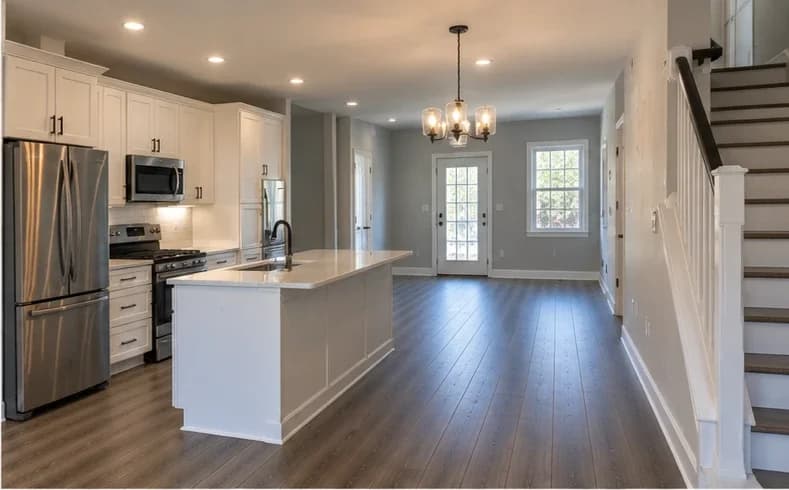
Rental Turnovers in Washington, DC
DC rentals sit above and below ground, from condos to English basements, and each one turns a little differently. We do make-readies for apartments and condos, rowhouse and basement turns and short-term rental repairs in all four quadrants, finished to the move-in date.
DC Rentals Live Above and Below Ground
A DC rental is rarely a plain apartment. It is a rowhouse split into flats, the English basement unit underneath, or a condo with building rules stacked on top of the city's.
Each one needs its own scope before the next tenant gets the keys. Miss an item and the unit fails its inspection and goes back on the calendar.
The local concept
The English Basement
An English basement is the half-below-grade unit under a DC rowhouse, with its own door under the front steps. You find them rented in every quadrant.
They sit on old masonry foundations, so moisture is normal down there. Before new drywall or flooring goes in, we test, then choose materials that can live with it.
A basement unit with a damp back wall is not a failed unit. It is a unit that needs mold-resistant board, flooring that shrugs off a little vapor, and an egress window that opens.
Why DC Landlords and Managers Call
Rowhouse flats in Columbia Heights and Petworth
Rowhouses split into two to four units turn one floor at a time. Paint, floors, fixtures and the housing-code items, each unit on its own written price.
Basement units
Moisture readings come first. Then LVP or tile on the floor, the right board on the walls, and working egress and alarms before the lease starts.
Condo and apartment buildings
Elevator reservations, a certificate of insurance and quiet hours are booked before the start date, so the building lets us in on day one.
Near the universities
Rental houses and flats near Howard University and the Catholic University of America turn on the academic calendar, when many leases end in the same weeks.
Short-term rental repairs
Repairs between guests: paint touch-ups, locks, furniture assembly, minor fixtures and the punch list before the next booking.
Passing the housing inspection
Alarms that work, ground-fault outlets in kitchens and baths, locks that secure, windows that move and no flaking paint, all handled before the inspector shows up.
What a DC Turn Covers
- Move-out walk and written scope per unit
- Lead-safe paint correction in pre-1978 housing
- Moisture testing in below-grade units
- Paint, patching and flooring
- Doors, locks, fixtures and hardware
- Housing-code items before the inspection
From Bryans Road to DC Rentals
Columbia Heights, Petworth and Brookland are about 19 to 20 miles from our shop in Bryans Road, all well inside our 30-mile area.
We drive MD 210 north and I-295 up the east bank of the Anacostia, then DC 295 and New York Avenue (US 50) into Northeast and across to the northern neighborhoods.
All Purpose Anytime Services, 6965 Heather Drive, Suite A, Bryans Road, MD 20616. View on Google Maps
DC Rental Turnover Questions
- What license does a DC rental need?
- A Basic Business License for rental housing from the Department of Licensing and Consumer Protection, and a unit that passes the housing-code inspection.
- Is moisture in my basement unit a problem?
- Some is normal in an old foundation. It decides the materials: we test first and pick flooring and wall board that hold up below grade.
- Does DC's lead rule apply to my unit?
- For pre-1978 housing with deteriorated paint, yes. DC expects that paint fixed using lead-safe work practices before a new tenant takes the unit.
- Can you turn a unit in a condo building?
- Yes. Send the building's contractor rules and we handle the insurance certificate, elevator booking and work hours before we start.
- Can you turn condos in the Navy Yard and Southwest Waterfront towers?
- Yes. Those newer units usually come down to wall touch-ups, a few replaced planks, new hardware and an appliance or two, booked around the building's move calendar.
- Can you handle several flats in one rowhouse at once?
- Yes. We walk every unit, write a price for each, and sequence the work so the flats with the earliest move-in dates finish first.
What to know about turning a District rental
Washington's rental housing is unlike the suburbs. A large share of units are rowhouses from the 1880s to 1930s, many converted into two to four units, plus English basement apartments under them, plus condo and apartment buildings from every decade since. The rowhouses carry plaster walls, original wood floors and old plumbing. The basement units carry moisture. The newer buildings turn on paint, LVP repair, hardware and appliances.
Renting a unit in the District requires a Basic Business License for rental housing from the Department of Licensing and Consumer Protection, and an inspection against the housing code. The inspection looks for working smoke and carbon monoxide detectors, GFCI protection, secure locks, windows that operate, no peeling paint and no active leaks. A turn that skips those items fails and sits empty another two weeks. We build them into the written scope.
DC's lead-safe rules apply to housing built before 1978, which is most of the city. Deteriorated paint in a pre-1978 unit has to be corrected with lead-safe work practices before a new tenant moves in, so patching and painting in an older rowhouse is a compliance item as much as a cosmetic one.
Condo and apartment buildings set their own rules on work hours, elevator reservations and sound-rated underlayment under new flooring. English basements below grade need moisture checked before new flooring or drywall goes in. We plan around both before the schedule is set, so the date you give the incoming tenant is the date the unit is ready.
Washington Neighborhoods We Serve
Get a Free Rental Turnovers Quote in Washington
Send the form or call (240) 695-4415. We answer every day, 7:00 AM to 7:00 PM.
We take insurance jobs. Financing may also be available for qualifying projects. See financing options.